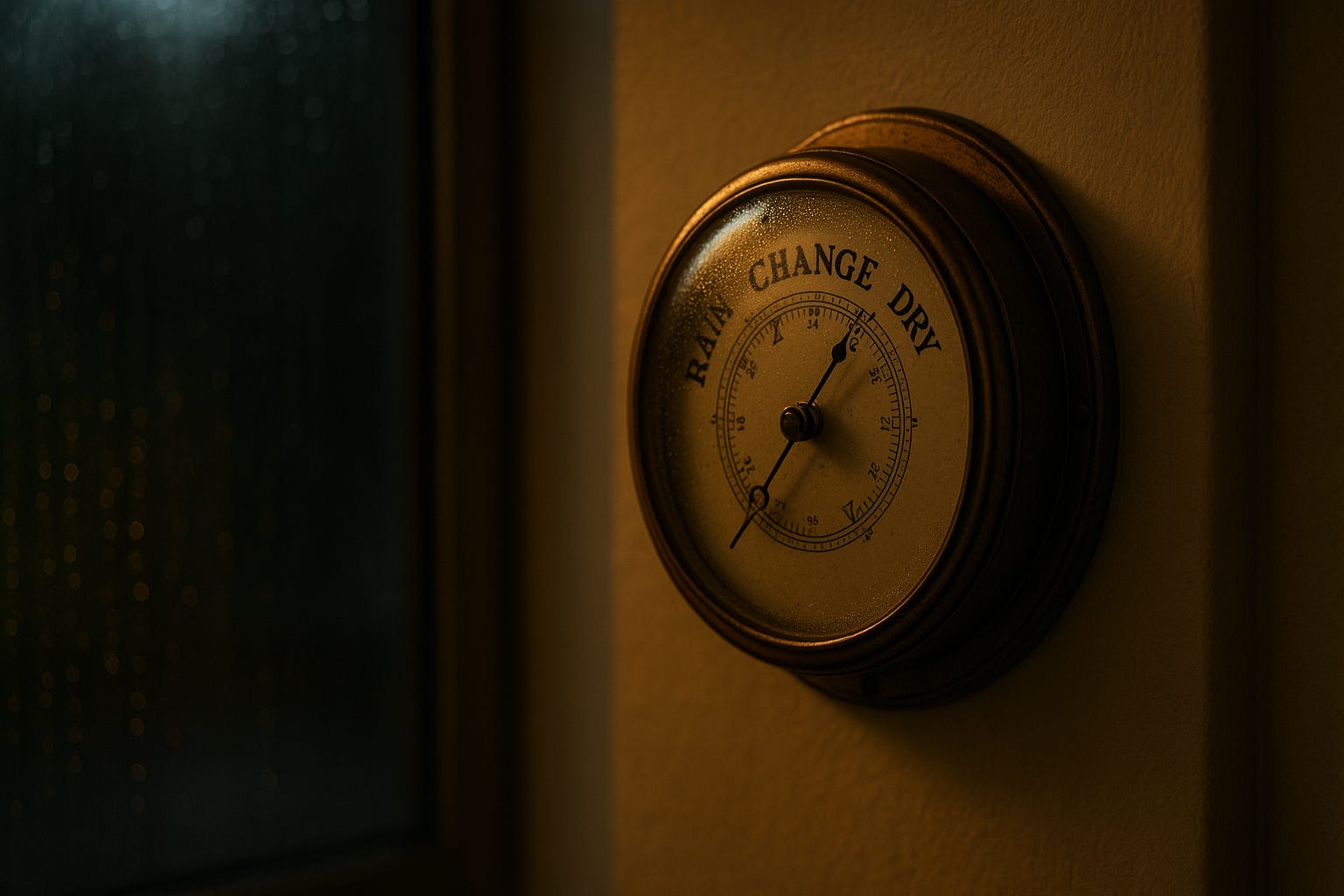
Rainy Day Arc I: Barometer
Pressure, Thunder, Skin… Part One of the Rainy Day Arc

A barometer doesn’t predict so much as register. It feels the shift and tells the truth. That’s how this started… long before the first flash, when the house takes on that quiet hush that makes doors open and the air turn soft as velvet.
Pressure
My wife, Amelia, was at the sink finishing dishes she didn’t need to finish. I was pretending to read, the spine of the book warm under my thumb while the air thickened in the room between us. Not tense… dense. A fullness. If anyone had asked me to explain it, I’d have pointed at nothing and said, “Here. Right here.” The kind of weather that makes a body feel itself fully.
“Can you open a window, Daddy?” she asked, as once our oldest called me Cal when she was one and a half, we adopted Mommy and Daddy as nicknames and they stuck. I nodded and cracked two an inch. Outside the sky was the colour of slate. Somewhere far off, a truck downshifted and the sound arrived rounded at the edges… as if the world had been wrapped in cotton.
I stood across from her and watched her as I set my book down. The barometer on the hallway wall, an old brass thing we never set properly, had tipped left sometime in the late afternoon. Falling. I could feel the same tilt in my chest. Amelia dried her hands on the tea towel and left it folded on the counter like a small flag of surrender.
“Come here,” she said, but her voice didn’t reach for me. It landed low, like a hand on a table that has already held every conversation worth having.
I crossed to her. We didn’t kiss. Pressure nights start with hands; not with lips. I set my palm at the back of her waist and felt how the day had left itself there. She leaned into it the way a boat moves into a harbour… just enough to call it home. My other hand found her hip and simply rested. Contact is a gauge: too light and it says I’m not sure; too hard and it says I’m trying. The right weight says, “I hear what you are telling me.”
The house answered. The fridge motor clicked off; the kettle settled; even the sounds of the street seemed to back away from our windows. Everything that could get quiet did, so the pressure could speak.
Thunder
When the first murmurs rolled in, Amelia shivered. Thunder is the sound a boundary line would make when it’s ready to be moved. She turned in my arms and looked at me like she was about to take something she owned all along.
“Slower,” Amelia said, though we weren’t moving. It was theology, not tempo. A rule we both understood: when thunder speaks, you adjust… less force, more presence; fewer plans, more skin.
I nodded, because an agreement is also a sound if you gesture correctly. I let my breath drop lower and matched it to hers. We stood like that while the sky cleared its throat. Somewhere overhead, the cloud architecture flexed. In the window’s reflection our bodies became two darker pieces of the same weather.
“Talk to me,” she asked. She didn’t mean conversation. Words are instruments here: pitch, volume, reverb. Thunder teaches you to make a voice that wraps rather than pokes.
“You’re safe,” I said, lower than usual, slower. More of an atmospheric condition than a performance. The words landed and her shoulders loosened. My hand slid from her hip to the back of her ribs and I felt the next roll of sound arrive inside her before it reached the roof.
Thunder gives rain permission to fall. Amelia’s eyes said yes the way the horizon says yes to the earth and becomes nothing but sky.
Skin
We moved to the doorway of the living room because doorways are barometers in houses, they mark the shift. I sat on the set of three stairs and she came into my lap sideways, knees tucked, her weight offered rather than placed. Skin’s first language is temperature. The room had cooled; she had not. I rested my cheek against her temple and let the contrast translate us.
Hands learned what was already explained. The inside of her wrist was a degree warmer than her palm; the curve of her shoulder held the day’s last heat; the small hollow above her collarbone gathered it all like a fall harvest. I traced a path between them slow enough that each place felt seen before I left it.
“Here,” Amelia said, guiding my hand to the long line of her side under her blouse. The thunder outside agreed with a quiet, approving rumble. It is a simple thing to move a hand from here to there; it is a holy thing to do it at the pace someone asks for.
We stayed mostly silent. When I did speak, it was in single words… good, there, yes. Each one carried on an exhale so it met her warm. Amelia answered the same way, sometimes with words, sometimes with that small sound you make when you have that comfort level between you.
The first lightning finally came, white behind closed clouds, lighting up the windows like a pulse seen through skin. For a heartbeat our reflection went flat and perfect; then it broke apart again into two living bodies, all texture and breath and damp at the hairline.
I pressed my lips into the place beneath her ear she pretends is ordinary. Amelia turned her head to offer more of it and the room changed temperature by impulse. I’d call that the first drop if I were naming weather, but I wasn’t; I was listening to skin translate the storm for me.
“Hands only,” she said, almost a question.
“Hands only,” I agreed, and felt the barometer inside me steady to that rule.
There is a discipline to this kind of night that turns out to be freedom. When you narrow the instrument list, you get virtuoso with what remains. Palms, fingertips, knuckles, the heel of a hand become the quartet. I played them against her back, her ribs, the angle where thigh becomes hip. She adjusted under me like a coastline meeting the tide coming in.
The rain arrived for real… soft at first, then confident. It pattered at two tempos: the roof’s steady brushwork and the window’s random beadwork. Her breath joined the section, found its place, and the room became an orchestra without effort. I matched the beat that lived under her sternum and held it until her shoulders rolled a fraction and the note changed.
“Stay right there,” Amelia whispered when I paused, and I did. Thunder rolled again, nearer now, and her hand found the back of my head like she was grounding the sky through me. The barometer on the wall, that poor old brass prophet, told no one, but my palms did. They knew exactly how low the pressure had fallen and how much room there was to fall still.
I won’t say what happened in the next minutes, because this isn’t that page. But I will tell you the weather’s part: when the first shiver ran through her, the roof sang louder as if given a cue, and when her breath broke and rebuilt itself softer, the thunder walked away like a satisfied guest. Skin finished the sentence that thunder began. Pressure wrote the preface, and her laugh, that quiet, astonished one was the epilogue.
After, we stayed where we were. Rain makes the best aftercare because it keeps talking when you’re quiet. I smoothed the damp hair at her temple and she drew circles at my chest with a fingertip, small, absent-minded, proprietary. The room smelled like the air had suddenly freshened. The windows sighed; the world got clean without our help.
“You felt it early,” Amelia said against my shirt.
“I heard it in your silence,” I answered.
We looked over at the hallway. The barometer sat where it always sits, slightly tarnished, needle pointed left like a hunting dog pointing at a bush. I thought of setting it properly; I didn’t move. We had a better instrument.
“Remind me,” she said, not opening her eyes, “what barometer means to us.”
“It means we don’t force the night,” I said. “We notice it.”
“And when thunder speaks?” Amelia asked, smiling.
“We lower our voices,” I said, “and listen with our hands.”
She nodded, the kind of nod you feel more than see. Outside, the rain settled into a pace meant for sleeping. Inside, skin found that pace easily. We didn’t turn on another light. We didn’t check another thing. We let the storm finish teaching and promised to remember: pressure, thunder, skin. The whole lesson, carried forward.
When we finally stood, her palm found mine without searching. The barometer on the wall kept its counsel. We didn’t need it to tell us anything we weren’t already willing to feel.