The Man Who Reached
What's a heaven for?

Elias built ladders for a living.
People liked to say that he made metaphorical ones, but no... real ladders. Ash wood, oak, spruce when money was thin. He built them in a narrow shop at the edge of town, where the road turned to gravel and the sky seemed larger than it did in town.
His ladders were good. Honest. Strong enough for roofers, chimney sweeps, orchard men, and foolish boys climbing where they shouldn’t. His father had built them before him, and his father before that.
But Elias was cursed with a terrible thing.
He could look up.
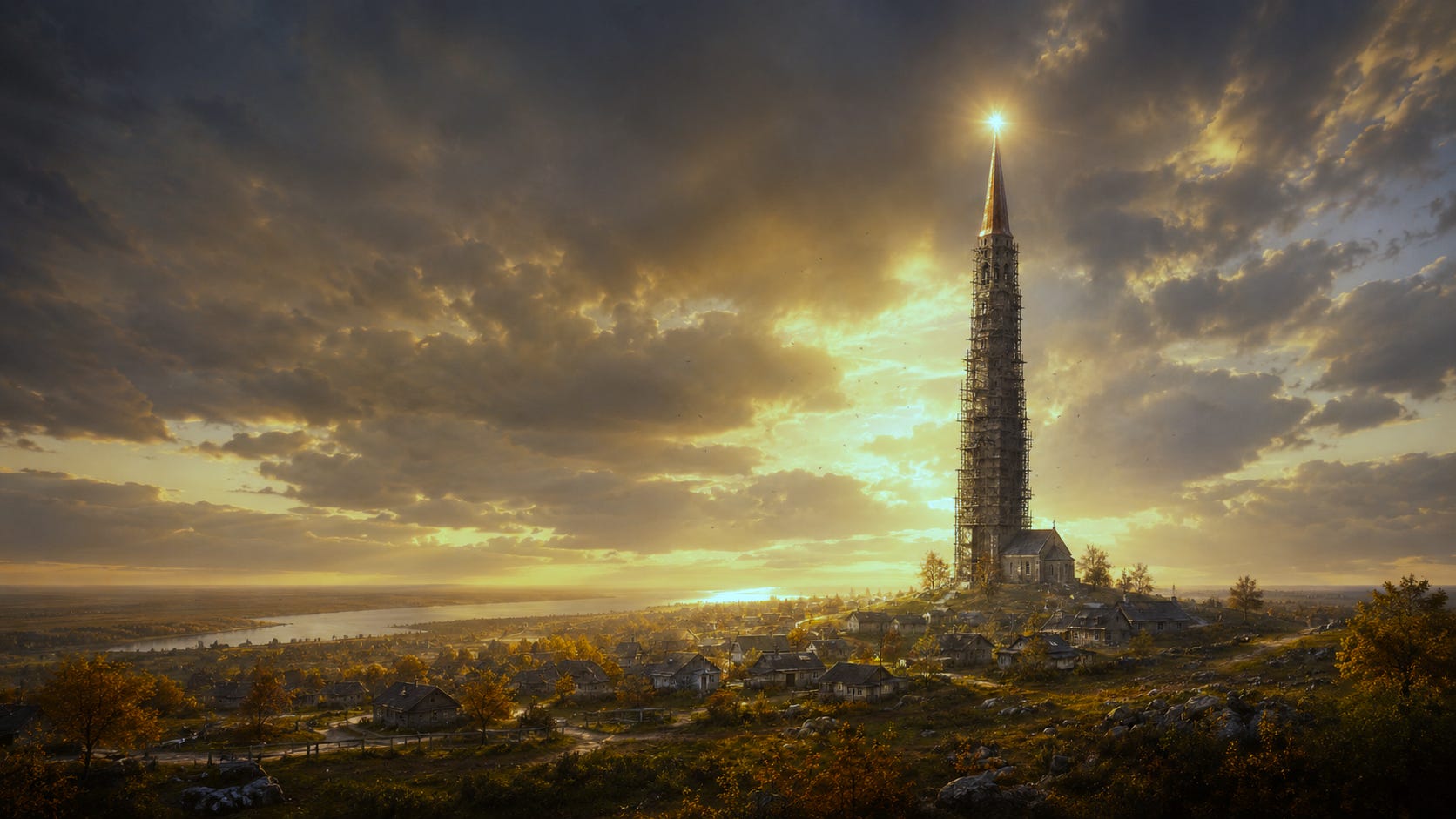
Every evening, when the shop was swept and the day’s sawdust clung to his sleeves, Elias would stand in the doorway and stare at the old bell tower on the hill. It had been abandoned for decades, its bronze bell cracked, its stones blackened by weather, its spire broken off.
No one cared about the tower. It had outlived its purpose.
Elias cared. He began to draw plans.
At first, the townspeople laughed kindly. Then less kindly. He wanted to restore the tower, patch it up, make it safe. He wanted to raise the spire higher than it had ever been. Higher than the church records claimed. Higher than sense allowed.
“You build ladders, Elias,” said Mayor Breen. “Don’t confuse that with building heaven.”
Elias smiled.
“Someone has to confuse the two, or we all keep staring at the floor.”
So he worked.
By day, he made ladders. By night, he carried tools up the hill and set stones by lantern light. He mortgaged the shop. Sold the good oak. Bartered labour for lime, rope, iron brackets. His hands cracked. His back bent. His wife, Dorothy, watched the coins vanish from the jar and said little.
One night, she found him asleep at the table, cheek pressed against a blueprint.
“You don’t have to touch the sky to prove you lived,” she whispered.
He stirred but did not wake. The tower rose.
Slowly, then suddenly, it became impossible not to see. From the market. From the mill. From the graveyard. Elias’s impossible spire climbed into the weather, thin and stubborn and almost beautiful.
The townspeople stopped laughing. Some brought food. Some brought stone. Some still muttered that pride was a ladder with rotten rungs.
Near the end, Elias built the final scaffold himself. It was too high.
Everyone knew it. Even Elias, though knowledge is a poor jailer when desire has already picked the lock.
On an autumn morning, with clouds moving fast and cold over the hill, Elias climbed. The whole town gathered below. Dorothy stood apart from them, one hand at her throat.
He reached the top and fixed the last copper point into place. For one breath, the tower was complete. Sunlight struck the spire. The copper flashed like fire. The town below turned gold. Even the broken bell seemed to hum, remembering its own voice.
Elias laughed. Then the wind came.
The scaffold shuddered. A plank twisted. His boot slipped. They said later that he fell reaching upward. Dorothy knew better. He fell with one hand out, yes, but toward the tower. Toward the thing he had made.
The spire remained for many years after. Too tall. Impractical. A little mad. Storms bent it. Birds nested beneath it. Children dared one another to climb the hill and touch its shadow.
People told the story different ways. Some said Elias was a fool who should have known his limits. Some said he was a visionary. Dorothy, when asked, would look toward the hill and say only this: “His reach exceeded his grasp. That was his sin.”
Then, after a pause, softer: “And also his gift.”