
Thirteen
I try to plan for it, but it doesn't work...

I don’t always cry at funerals.
Just… most of them.
It’s not about how well I knew the person. Sometimes I do. Sometimes I don’t. Today? Somewhere closer to the former. Enough to have a memory or twenty, a laugh shared in a kitchen, a warm plate passed my way during a holiday that I didn’t quite belong to yet.
But even if I’d never met her, this would’ve happened anyway.
The moment we walked into the chapel, that familiar tightness crawled up my spine. The floral arrangements. The low, reverent hum of strangers doing their best not to cry too loudly. The way people shift in pews like they’re auditioning for grief instead of drowning in it.
By the time one of the immediate family, my wife’s extended family, stood to speak I was already back “there”.
Thirteen again.
I can still smell the starch in my Sunday shirt. Feel the scratch of my oversized suit jacket on the back of my neck. See the rest of my family (minus one) stood in a different room, on a colder day, where I had both hands clenched at my sides and the only soul (my mom) who could tell me how to deal with this was the one we were all there for.
My wife was beside me now… quiet, composed. Her fingers laced with mine, but gently. To remind me that I’m here, not there.
Still, the tears come. Slow. Silent. As if the weight inside me needed somewhere to leak before it flooded everything.
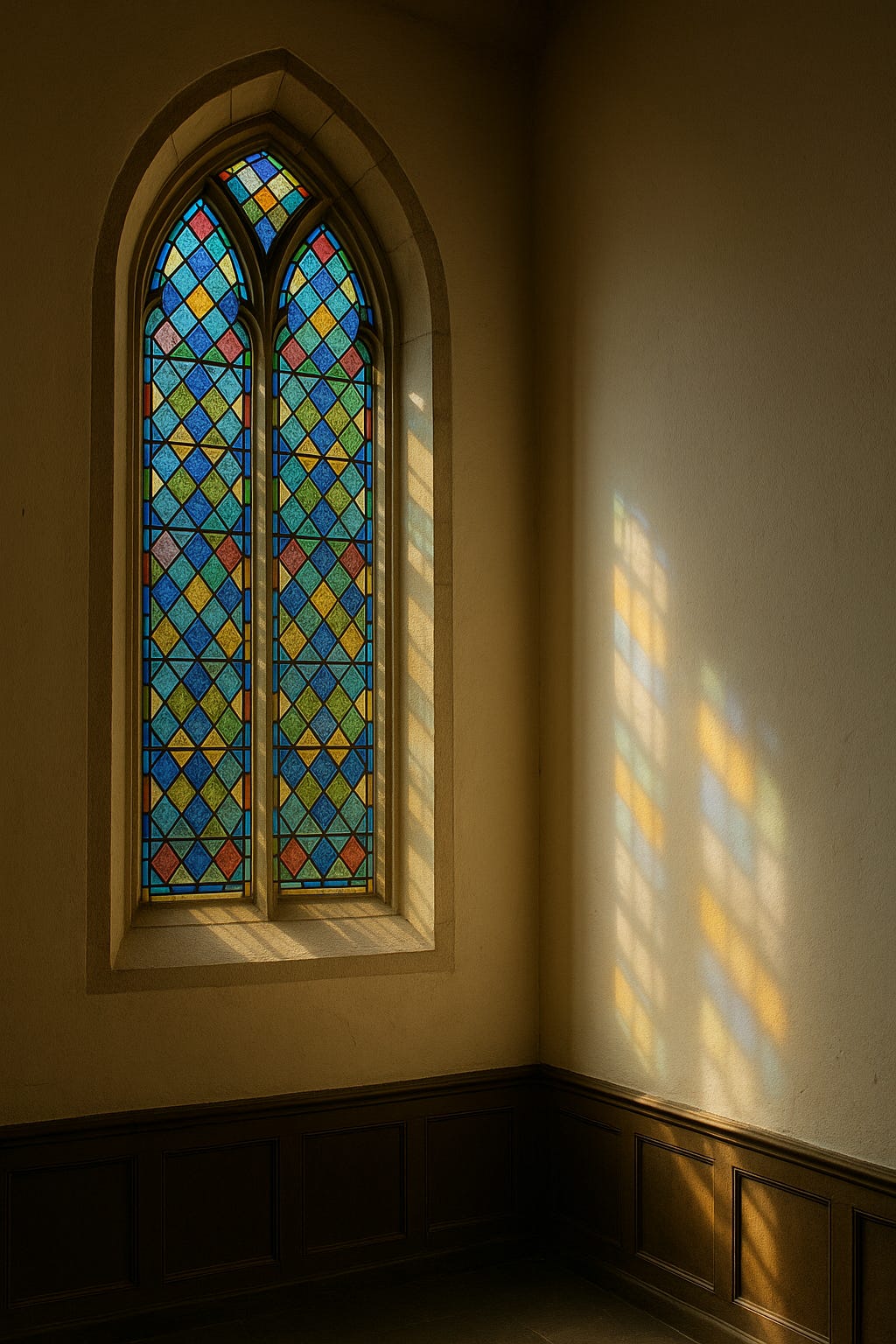
I turned slightly, angling away from the front of the room. I needed to breathe. Just one breath of air that didn’t want to come. The stained-glass windows were soft with afternoon light. Blue and amber spilled down the floor like divine confetti, celebrating something no one asked for.
The eulogy began, and I listen. Sort of.
“…a quiet strength… always knew how to make you feel welcome…”
I don’t disagree.
She was and she did.
She made room for people… even me, when I wasn’t sure I counted yet. The kind of woman who made you a plate and made you feel like you were supposed to be there. The kind of woman who asked about your job, your kids, your favorite movie, because she actually did want to remember.
I remember her smile. That helps.
But I’m still thirteen.
Still grieving someone the world never properly mourned. Someone who is right behind my shoulder every time the word “beloved” is said.
The service ends. We file out.
My wife says little, but she squeezes my hand again. Doesn’t ask. She knows the pattern. Knows that some echoes loop. Over and over. Like a boy frozen in time, stuck just outside a moment he never got to finish.
In the car, I exhale hard.
“You okay?” she finally asks steadily.
I nod.
Then, I speak a beat later: “It’s always her.”
She looks over. “I know.”
And that’s all there is to say.
Not every grief belongs to the moment. Some moments borrow it.
A deeply moving reflection on the layered nature of grief. Calder Quinn captures with quiet precision how mourning is rarely confined to the present, how it loops, echoes, and folds back into earlier losses. The writing is tender, restrained, and achingly honest, with the image of “divine confetti” falling through stained glass offering a moment of unexpected grace. “It’s always her” is a line that lingers, revealing how some absences remain stitched into the fabric of every farewell. A poignant reminder that grief is not linear, and memory is its own kind of presence.
This is beautiful and I can relate to the emotions and how it all just....*feels*. So many layers to it all.